
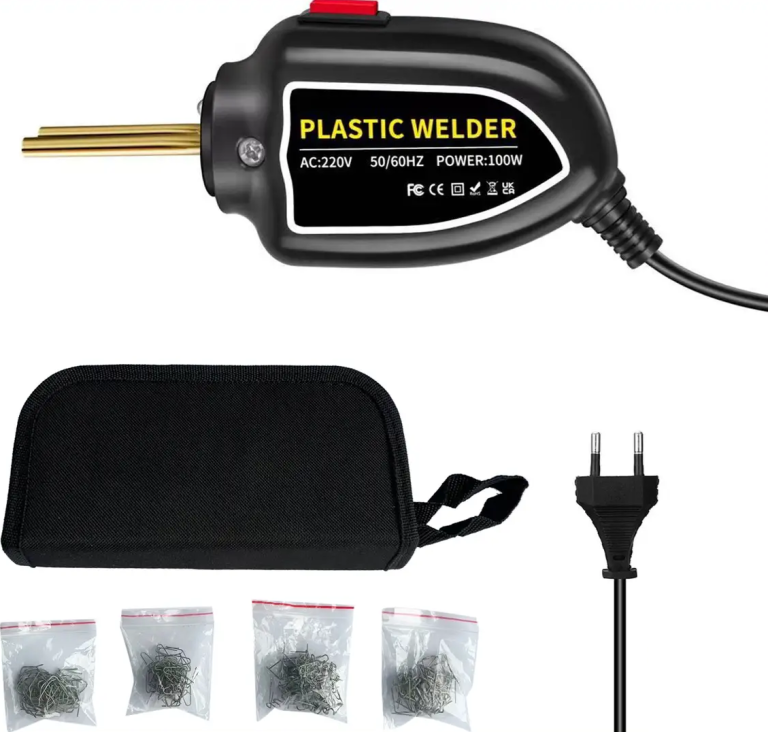
For cracks in bumpers, headlights and housings, get a 50 W hot stapler with 0.6 and 0.8 mm staples — it pulls the crack together from the back in minutes. A welding iron with a plate or tips is needed when the seam has to be filled with rod, a tank has to be sealed, or a broken-off piece rebuilt. If your repairs vary, choose a 3-in-1 unit or a two-tool kit.
Plastic is repaired in two ways, and each needs its own tool. A hot stapler melts a heated stainless-steel staple into the part: it pulls the crack edges together and works like rebar. A plastic welding iron melts the part itself together with a rod of the same plastic: this fills the groove, closes the seam and makes it watertight. Most serious repairs combine both — staples on the back, rod on the front.
Hot stapler: when it is enough
A hot stapler is the fastest way to give a part its strength back. The staple heats up in 1–3 seconds, sinks into the plastic to about half its thickness and sets together with it. For a crack in a bumper, a headlight housing, a trim panel or a plastic mount this is often all you need: the repair takes 10–20 minutes including prep.
- Power. 50 W is enough for 0.6 and 0.8 mm staples — exactly what the H50 staplers have. More power heats faster but does not make the seam stronger.
- Staples in the box. It helps to have at least four shapes: wave for straight cracks, small wave for short ones, M- and L-shaped for corners.
- Case and side cutters. Staple legs are trimmed after every repair, so cutters in the kit are not a minor detail.
Body-shop pros on the GarageJournal forum recommend putting staples on the back of the part and finishing the front cosmetically — with rod, plastic filler and paint. And check the marking first: on polyurethane bumpers (>PUR<, found on some Mercedes and Chrysler models) staples hold poorly.
based on a GarageJournal discussionPlastic welding iron: when you cannot do without it
You need a welding iron when the part has to hold liquid, when a piece has broken off, or when the seam must be smooth for paint. There are two types:
- With a wide plate — like the TS-32 with a 6×2.5 cm oval plate, 50 W. It softens a strip along the crack in one pass and smooths it right away. Good for bumpers, trim and garden furniture.
- With a tip — a 110 W mains iron with a removable tip and a large nozzle for long seams. A removable tip is easier to clean of stuck plastic.
Combination units and kits
If your repairs vary — a bumper today, a tank tomorrow — it pays to buy one unit that does everything. The PayPayPlast 3-in-1 works as a hot stapler, a welding iron and a plastic welding gun, and comes with 200 staples in four shapes and a pouch. The two-iron kit (50/100 W plus a hand iron) with smoothing tips, mesh and PP rods covers “weld a chip or a hole” with no extra purchases.
Which tool for which job
| Job | Tool | Consumables |
|---|---|---|
| Crack in a bumper, headlight, trim | 50 W hot stapler | Wave staples, 0.6 or 0.8 mm |
| Crack in a corner or on a rib | Hot stapler | M- and L-shaped, corner staples |
| Tank or canister leaks | Iron with a plate or smoothing tip | Rod of the same plastic |
| Broken tab, chip, hole | Hot stapler and iron | Staples, mesh, rod |
| Smooth seam for paint | Iron with a smoothing tip | Rod, P120–P320 sandpaper |
Tips: an easy way to do more with one iron
Interchangeable tips fit electric irons up to 80 W with a 5.6 mm shank. The wide smoothing tip (20 mm) heats large areas and melts in mesh, the small triangle (16 mm) gets into narrow cracks and onto headlight tabs, and the mini extruder melts rod right in the groove — feeding and smoothing in one pass.
Hotter does not mean stronger. Polyvance ran peel tests: samples welded too hot turned out noticeably weaker than those welded at the recommended temperature. Don’t hold the button longer than needed and never heat plastic until it smokes.
Common buying mistakes
- Buying the cheapest iron without staples and then buying staples piece by piece — a kit with a stock of staples works out better.
- Buying only a stapler for a leaking tank: staples hold but don’t seal — without rod of the same plastic the seam will weep.
- Not checking the part’s marking. How to identify plastic by the letters in angle brackets is explained in “PP, ABS or PE”.
FAQ
Is 50 W enough for a bumper?
Yes. 50 W is enough for 0.6 and 0.8 mm staples: a staple heats up in 1–3 seconds. For melting large areas with rod, a 100–110 W iron is more convenient.
Do other brands’ staples fit?
The staples are standard — 0.6 and 0.8 mm wire for household hot staplers. Staples from our catalogue fit every hot stapler we sell.
Can I use an electronics soldering iron?
For small jobs, yes, but the tip clogs with plastic quickly and there isn’t enough power for a bumper. A dedicated plastic iron lasts longer and heats more evenly.
What should I buy for a few repairs a year?
A 3-in-1 unit or the H50 kit with staples: they cover most home repairs of bumpers, headlights and trim.
Sources and workshop experience
- GarageJournal — body-shop discussion: staples on the back, cosmetic work on the front, limits on urethane bumpers
- Repairer Driven News / Polyvance — peel tests: overheating weakens plastic welds
- Wikipedia: Plastic repair welder — how a hot stapler works and what the staples are made of
Updated 30.09.2026 · PayPayPlast editorial team — we test the advice on our own repairs