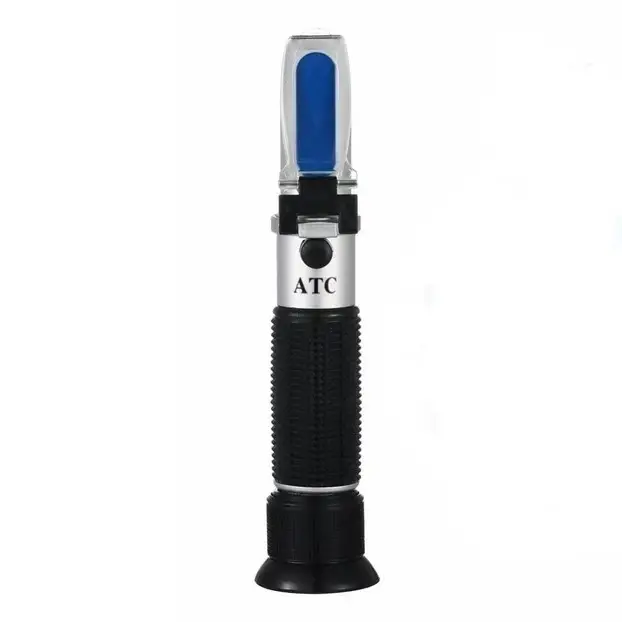
Calibrate the refractometer with distilled water: 2–3 drops on the prism, wait half a minute and turn the screw until the boundary sits on 0 (WATERLINE). Then wipe the prism, add 2–3 drops of cold fluid from the reservoir and look towards the light: the blue/white boundary on the right scale shows the freezing point of coolant (separate G11/G12 and G13 scales) or washer fluid, or battery acid density. In a Ukrainian winter, coolant should protect to at least −30…−35 °C; a charged battery reads 1.27–1.28 kg/l.
Coolant gets diluted with water over time, the washer fluid a garage topped up may have been a summer mix, and the battery loses charge just before the first frosts. You can see all of it in advance: an optical refractometer shows freezing point and density from two or three drops, with no batteries and no trip to a workshop.
What a car refractometer measures
The eyepiece shows several scales. On the RZ-115 / RHA-503ATC:
- G11/G12 coolant (ethylene glycol) — 0 to −50 °C.
- G13 coolant (propylene glycol) — also 0 to −50 °C, but on its own scale.
- Washer fluid — 0 to −40 °C.
- Battery acid — density from 1.10 to 1.40 kg/l.
Automatic temperature compensation (ATC) corrects readings when the air is between +10 and +30 °C.
Step 1. Calibrate
- Open the cover and wipe the prism with a clean soft cloth.
- Put on 2–3 drops of distilled water — not tap water — and close the cover so it spreads with no bubbles.
- Wait about 30 seconds for the sample to reach the tool’s temperature.
- Look through the eyepiece towards the light and turn the calibration screw until the blue/white boundary sits exactly on the 0 line — WATERLINE.
Optical refractometer users on the American homebrewers’ forum agree on a simple routine: calibrate with distilled water before every measuring session, and recalibrate when the room temperature changes noticeably — one of them found his reading drifted when the evening turned cold. And read each sample two or three times to make sure the result is stable.
based on the American Homebrewers Association forumStep 2. Take a sample
- Coolant — from the expansion tank, only with a cold engine. When hot, the system is under pressure and an open cap sprays boiling fluid.
- Washer fluid — from the reservoir, ideally after it has settled rather than right after topping up.
- Battery acid — only from serviceable batteries with caps. It is acid: gloves and goggles are a must.
Step 3. Read the scale
Wipe the prism after calibration, add 2–3 drops of fluid with the pipette, close the cover and look towards the light. The blue/white boundary on the right scale is your result.
| Fluid | What it shows | What to aim for |
|---|---|---|
| Coolant | Freezing point | For most of Ukraine — at least −30…−35 °C |
| Washer fluid | Freezing point | In winter — below the coldest night, usually −20 °C or lower |
| Battery acid | Density, kg/l | 1.27–1.28 — charged; about 1.23 — roughly a quarter discharged; below 1.20 — charge it |
Don’t mix up the G11/G12 and G13 scales: ethylene and propylene glycol coolants give different readings at the same concentration. The type is printed on the bottle — or ask the garage what they filled.
Step 4. Clean the tool
Straight after measuring, wipe the prism with a damp cloth and dry it. Especially after battery acid: acid left on the prism damages the tool and the hands of whoever picks it up next. Keep the refractometer in its case.
Common mistakes
- Calibrating with tap water. Dissolved salts shift the zero.
- Bubbles under the cover. A blurry or broken boundary means the sample wasn’t spread evenly.
- Hot fluid. Readings drift, and sampling a hot system is dangerous too.
- The wrong scale. Especially G11/G12 versus G13.
- “Neat concentrate to be safe”. Pure coolant concentrate freezes earlier than a properly diluted mix — more is not better.
Check the washer fluid every autumn — summer fluid in the reservoir pushes the walls apart at the first frost and the tank cracks. If that has already happened, see how to weld the crack in the washer reservoir guide.
FAQ
Why a refractometer rather than a float hydrometer?
It needs two or three drops instead of a full bulb of fluid, readings don’t depend on the angle, and one tool measures coolant, washer fluid and battery acid.
How often should I calibrate?
Before each measuring session and whenever the garage temperature changes noticeably. It takes a minute.
Can it measure AdBlue?
This model has no AdBlue scale. It is made for coolant, washer fluid and battery acid.
Does it work for gel and sealed batteries?
No: there is no access to the electrolyte. Such batteries are checked with a voltmeter or a load tester.
Sources and workshop experience
- American Homebrewers Association Forum — optical refractometer users on calibrating with distilled water, temperature effects and repeat readings
- Mettler Toledo: Refractometry tips and hints — an instrument maker’s tips: a clean prism, a bubble-free sample, temperature
Updated 30.09.2026 · PayPayPlast editorial team — we test the advice on our own repairs
Read next
 Handy in the carHow to program a universal 433 MHz remote for gates and barriersA duplicate of your gate, garage or barrier remote takes a minute — if your remote uses a fixed code. How to check that, clear the memory and copy each button.3 min readRead
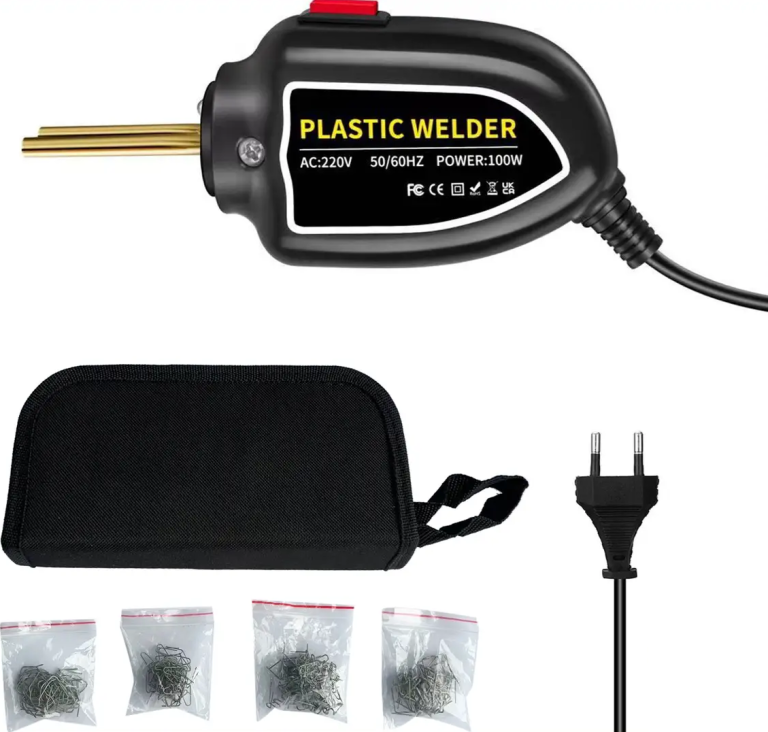 Plastic weldingHow to choose a hot stapler or a plastic welding ironStaples or rod, 50 or 110 W, a kit or just the tool. We compare the options and explain what to buy for your repair.4 min readRead
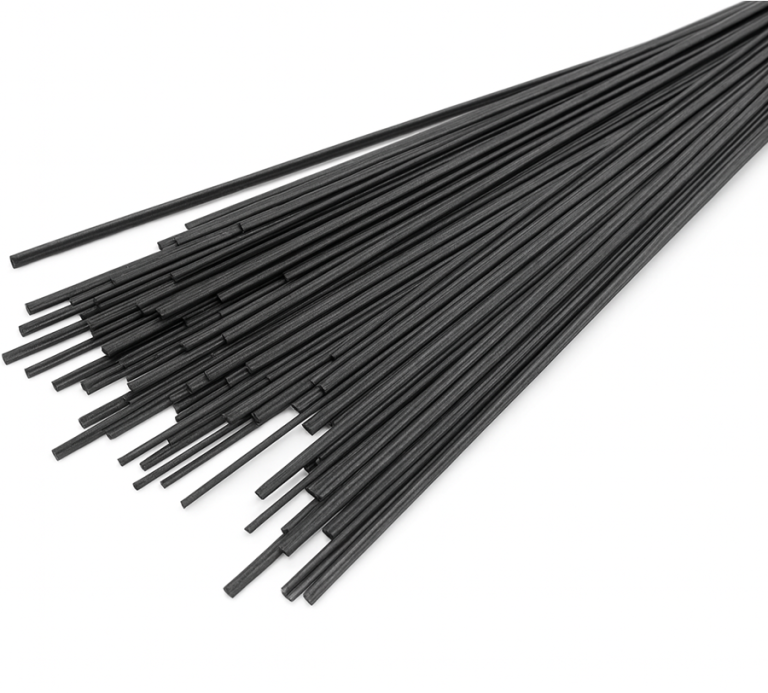 Plastic weldingHow to weld plastic with a rod: step by step and 7 mistakesGroove, heat, rod feed and cooling. How to make a seam that won’t chip off, and what not to do even “to save time”.4 min readRead
Cannot find your case? Message us on Telegram and we will tell you exactly what to take for your part.
Message us on Telegram